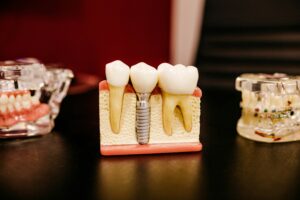
If you’ve been told you don’t have enough jawbone for a standard implant, or you’re looking for a way to keep a loose denture in place, mini dental implants may have come up as an option. They’re smaller, less invasive, and often quicker to place than traditional implants, but they aren’t the right fit for every case. Here’s how mini implants work, where they shine, and where a full-size implant is still the better long-term choice.
What Are Mini Dental Implants?
Mini dental implants are narrow, one-piece titanium posts that anchor into the jawbone to support a crown or hold a denture in place. They work on the same basic principle as a traditional implant, but they’re less than 3 millimeters wide and built as a single piece, so the post and the attachment for the tooth or denture are one unit.
Traditional implants, by comparison, are typically a two-piece system: a post that fuses with the bone and a separate abutment that connects to the final restoration. Standard implants generally measure about 3.25 to 5 millimeters across, which gives them more surface area to bond with bone and more strength under chewing pressure.
How Do Mini Implants Compare to Traditional Implants?
The main differences come down to size, strength, and how much bone each one needs. Mini implants trade some long-term strength for a simpler procedure, while traditional implants require more bone but hold up better under heavy chewing forces.
| Mini Implants | Traditional Implants | |
|---|---|---|
| Width | Under 3 mm | About 3.25–5 mm |
| Design | One piece | Two pieces (post + abutment) |
| Bone needed | Less; grafting often avoided | More; grafting sometimes needed |
| Procedure | Less invasive, often local anesthesia | Surgical, with a longer healing phase |
| Bite strength | Lower load capacity | Built for full chewing force |
| Common uses | Stabilizing lower dentures, small front teeth | Single teeth, bridges, full-arch restorations |
Who Is a Good Candidate for Mini Dental Implants?
Mini implants tend to suit patients who want a more secure denture, have lost some jawbone, or need to replace a small tooth in a narrow space. They can be a good fit for people who want to avoid bone grafting or who prefer a shorter, less involved procedure.
Some situations make mini implants a less reliable choice, including:
- Heavy teeth grinding or clenching, which can overload a narrow post
- Replacing molars, where chewing forces are strongest
- Active gum disease or significant gum recession
- Health conditions that affect healing, such as uncontrolled diabetes or bone disorders
- Smoking, which raises the risk of implant problems of any size
These factors don’t automatically rule someone out, but they do shift the conversation toward what will hold up best over time.
What Is the Procedure Like?
Because mini implants are narrow, they can often be placed through a small opening in the gums rather than a larger surgical incision. That usually means less discomfort, a shorter appointment, and a quicker return to normal routines, with many patients back to their usual activities within a day or two.
In some cases, a denture can be fitted to the mini implants on the same day they’re placed. Soft foods are recommended at first while the gums settle, and over-the-counter pain relief is usually enough to manage any soreness.
Are Mini Implants Cheaper Than Traditional Implants?
Mini implants often cost less per implant than traditional implants, mainly because the procedure is simpler and bone grafting is less likely. That said, the right comparison isn’t just price per post. If mini implants can’t handle the forces in your mouth and need to be replaced or supplemented later, the long-term cost can end up higher than choosing a full-size implant from the start. A written, all-in treatment plan makes it easier to compare options fairly.
Mini Implants vs. Other Full-Arch Options
For patients missing all of their teeth, mini implants are one of several ways to secure a denture. Other options include implant-retained dentures on standard implants and fixed full-arch solutions like All-on-4 dental implants, which attach a complete arch of teeth to four implants. Fixed options feel the most like natural teeth, while removable implant-retained dentures are easier to clean and typically cost less. The best choice depends on your bone, your bite, and how you want your teeth to feel day to day.
Find Out Which Implant Option Fits You
Choosing between mini and traditional implants comes down to precise measurements of your bone, bite, and goals. At Jovan Prosthodontics in Round Rock, Dr. Ace Jovanovski, a board-certified prosthodontist and the only dentist in the world to hold a Master Certificate in Dental Technology, uses CBCT 3D imaging and guided surgery software to plan every dental implant case before treatment begins. Request a consultation or call (512) 716-1200 to learn which option will hold up best for you.
Key Takeaways
- Mini dental implants are one-piece posts under 3 millimeters wide, compared with roughly 3.25 to 5 millimeters for traditional two-piece implants.
- They’re most often used to stabilize a lower denture or replace small teeth in tight spaces.
- Placement is usually less invasive, and many patients avoid bone grafting.
- Their smaller size means they handle less bite force, so they aren’t ideal for back teeth or patients who grind.
- A 3D evaluation is the best way to know whether mini or full-size implants fit your mouth and goals.
Frequently Asked Questions
Do mini dental implants hurt?
Most patients describe mild soreness rather than pain. Placement is usually done with local anesthesia, and discomfort afterward is typically manageable with ice and over-the-counter medication.
How long do mini dental implants last?
Standard mini implants are intended to be a long-term solution when they’re well cared for, though some temporary versions are only designed to last a few months to a few years. Ask which type is being recommended for your case.
Can mini implants hold a full denture?
Yes. Stabilizing a lower denture is one of the most common uses for mini implants, since they can reduce slipping and the need for denture adhesive.
Can I get mini implants if I was told I don’t have enough bone?
Possibly. Mini implants need less bone than traditional implants, so some patients who would otherwise need grafting can still be candidates. A 3D scan is the most reliable way to find out.